
When a Brand Quirk Becomes a Campaign
A brand name is usually the first thing people remember about a brand.
But what if it’s also the thing they keep getting wrong?
“Laf-ro-ig?”
“Lap-roy?”
“Laf-rog?”
If you’ve ever tried saying Laphroaig out loud, you probably understand the struggle.
For years, “How do you pronounce Laphroaig?” has been one of those questions that naturally comes up around the brand. Instead of treating that confusion as something to correct, Laphroaig recently turned it into the centre of a campaign.
And that raises an interesting question for marketers:
What if the thing people find confusing about your brand is actually the thing that can make your brand memorable?
When a pronunciation problem becomes a content idea
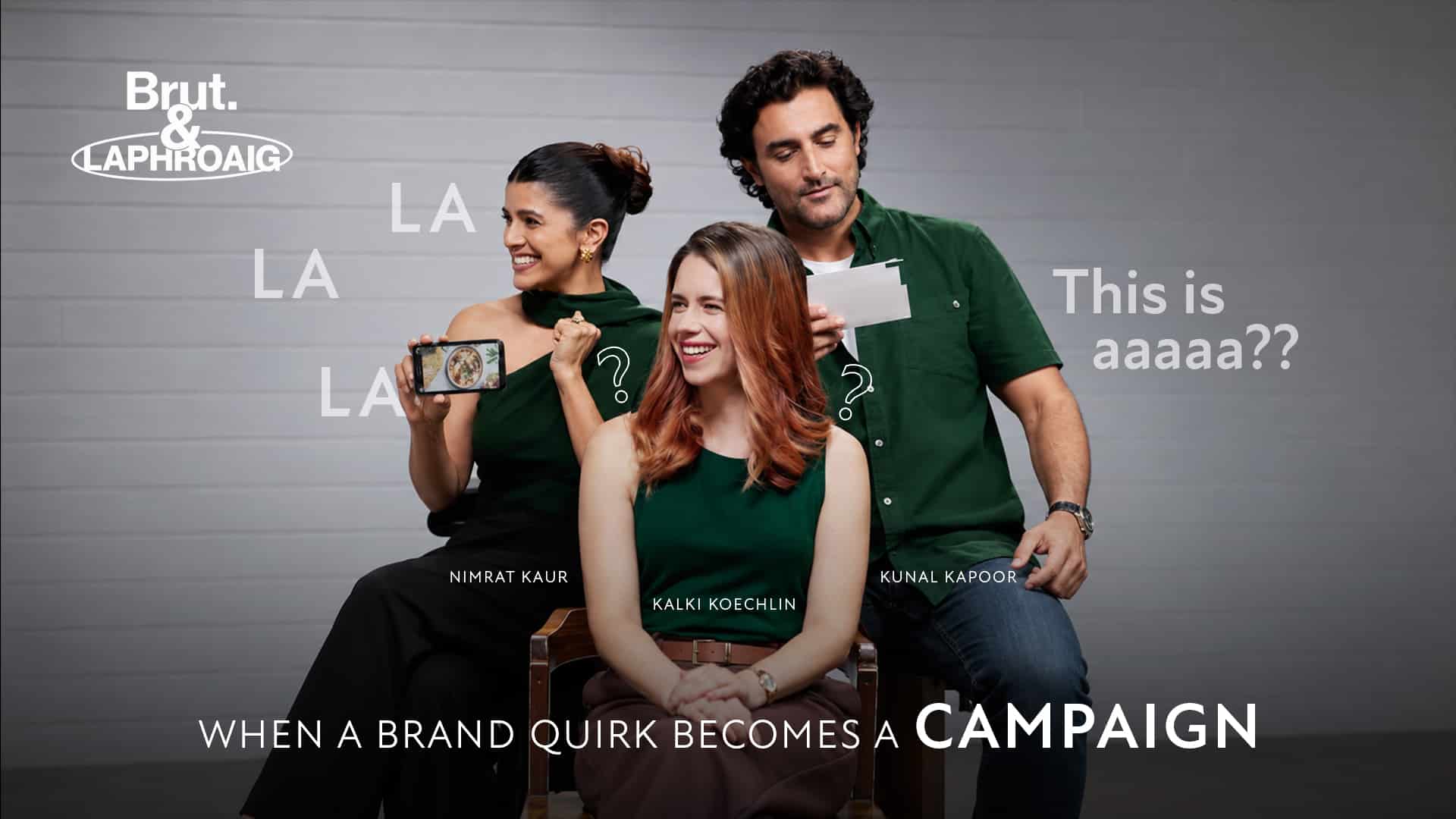
Laphroaig, in partnership with Brut India, created Friends of Laphroaig, a social-first series featuring Kalki Koechlin, Nimrat Kaur and Kunal Kapoor.
The premise was simple: take a question people already ask about the brand, How do you pronounce Laphroaig? and turn it into entertainment.
Three actors were put through pronunciation challenges involving difficult names, places and words before eventually taking on Laphroaig itself. And the casting had its own layer of relevance: the actors know what it feels like to have their names mispronounced.
The brand could have simply made a video saying:
“Laphroaig is pronounced La-FROYG.”
Problem solved.
But that would have been a correction.
Instead, Laphroaig made the confusion itself the content.
And that’s where the idea becomes interesting.
Your brand already has stories. Are you noticing them?
Marketing often begins with a question like:
“What should we say about our brand?”
But sometimes a better question is:
“What are people already saying about our brand?”
Because consumers are constantly creating little stories around brands.
They mispronounce names.
They give products nicknames.
They ask the same questions repeatedly.
They argue about how something should be said.
They complain about one particular feature.
They develop strange habits around using a product.
They turn brand quirks into jokes.
Most of these moments never make it into a marketing brief.
But they can contain something incredibly valuable:
a behaviour that already exists.
The marketer’s job isn’t always to invent a new behaviour.
Sometimes, it’s to spot the one that’s already happening.
Laphroaig isn't the only brand to do this
Take IKEA.
The Swedish furniture giant has something almost every customer around the world has experienced: its product names can be difficult to pronounce.
Instead of hiding behind the complexity, IKEA UAE recently turned it into The Swedish Test, a TikTok activation where people were challenged to pronounce IKEA product names correctly, moving from familiar names like LACK and BILLY to trickier ones such as BJÖRKSNÄS.
The clever part?
IKEA didn’t need to invent a new brand asset.
The names were already there.
It simply connected an existing brand characteristic with a format people already enjoy on TikTok: pronunciation challenges.
The brand quirk became the game.
The game became the content.
And the content gave people a reason to interact with the brand.
The insight isn't the name. It's the behaviour around the name
And that’s the bigger lesson here.
It’s easy to look at these campaigns and conclude:
“Okay, difficult brand names make good campaigns.”
That’s not really the point.
The real opportunity lies in identifying what people do because of your brand.
Laphroaig → People struggle to pronounce it.
IKEA → People struggle with its Swedish product names.
The name is simply the starting point.
The behaviour is the insight.
And the insight becomes the idea.
So, what's your brand's version of “Laphroaig”?
Maybe it’s not pronunciation.
Maybe customers constantly ask:
“Why is your product called that?”
Maybe everyone uses your product differently from how you intended.
Maybe there’s a recurring complaint sitting underneath hundreds of comments.
Maybe your product has a weird little ritual that every customer seems to have.
These aren’t necessarily things that need to be fixed.
Some of them might be creative assets waiting to be recognised.
And that’s when a marketer should stop and look a little closer.
Don't just look for what your brand can say
Look at what people are already saying about it.
Because the next campaign idea might not need another brainstorm.
It might already be sitting in your comments.
In your reviews.
In the question your customer service team answers every day.
Or, like Laphroaig, it might simply be hiding in the way people say your name.
Sometimes, the best thing about your brand is the thing you thought you had to explain.
And sometimes, all it takes to turn a brand quirk into a campaign is to stop correcting it—
and start listening to it.